Bispecific antibody-targeted mRNA delivery for next-generation personalised medicines.
Efficient delivery of mRNA-lipid nanoparticles (LNPs) to specific cell types remains a major challenge for mRNA cancer vaccines and mRNA immunotherapy. Our centre has developed a generalizable platform that uses bispecific antibodies (BsAbs) to bridge mRNA-LNPs and cell surface markers, enabling precise, targeted mRNA delivery for personalised cancer vaccine applications beyond the liver.
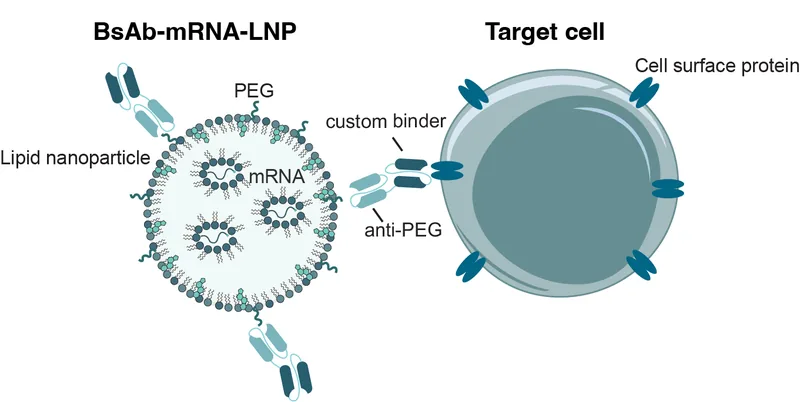
Unlike conventional approaches that modify the lipid composition or functionalize the LNP surface — which complicates mRNA manufacture and alters nanoparticle properties — our BsAb technology leaves the mRNA-LNP unmodified. This innovation enables simplified personalised mRNA production while maintaining efficacy. One arm of the bispecific antibody binds to PEG on the LNP surface, while the other arm carries a custom binder that recognises a protein enriched on the target cell. This bispecific antibody targeting technology was originally developed by Dr Chris Howard and has since been adapted for mRNA cancer vaccine and mRNA immunotherapy delivery by our team.
BsAbs form a molecular bridge between mRNA-loaded lipid nanoparticles and target cells.
A flexible, modular platform for targeted mRNA drug delivery.
Bispecific antibodies efficiently deliver mRNA-LNPs to specific cell types in vitro and in vivo, significantly improving mRNA immunotherapy uptake and personalised cancer vaccine efficacy.
Our mRNA cancer vaccine platform enables customisable targeting across a broad range of primary cell targets by simply substituting the cell-targeting binding region, advancing personalised mRNA medicine development.
miRNA binding sites can reduce expression in off-target organs, increasing the precision and safety of targeted mRNA delivery.
The platform is compatible with all current PEG-containing LNPs, requiring no modification to existing nanoparticle formulations.
Separate mRNA-LNP and bispecific antibody production streamlines personalised mRNA manufacture, enabling faster mRNA cancer vaccine development while keeping each component independently optimisable.
The application is de-risked as both mRNA-LNPs and antibody technologies are already in extensive clinical use worldwide.
Two complementary approaches for targeted mRNA-LNP delivery.
BsAbs are attached to the surface of mRNA-LNPs before administration. One arm binds PEG on the LNP; the other arm is free to engage cell surface proteins upon reaching the target tissue.
Cells are first exposed to BsAbs that bind to surface proteins. Unmodified mRNA-LNPs are then administered and retained at the target site via the PEG-binding arm. This novel approach preserves LNP properties and achieves superior delivery compared to pre-mixing.
Dietmair B, Humphries J, Mercer TR, Thurecht KJ, Howard CB, Cheetham SW. Targeted mRNA delivery with bispecific antibodies that tether LNPs to cell surface markers. Molecular Therapy: Nucleic Acids, Vol. 36, June 2025.
Read the Paper →We welcome collaborations with researchers and industry partners to advance personalised mRNA cancer vaccines and mRNA immunotherapy for cancer treatment and prevention.
Get in Touch →